
Supreme Court Flags Vehicular Pollution, Seeks Action Plan From Delhi and Three States
Vehicular emissions matter to be heard on Nov 23 and solid waste management matter to be heard on Nov 25, and crop-residue burning and firecrackers on Nov 25.

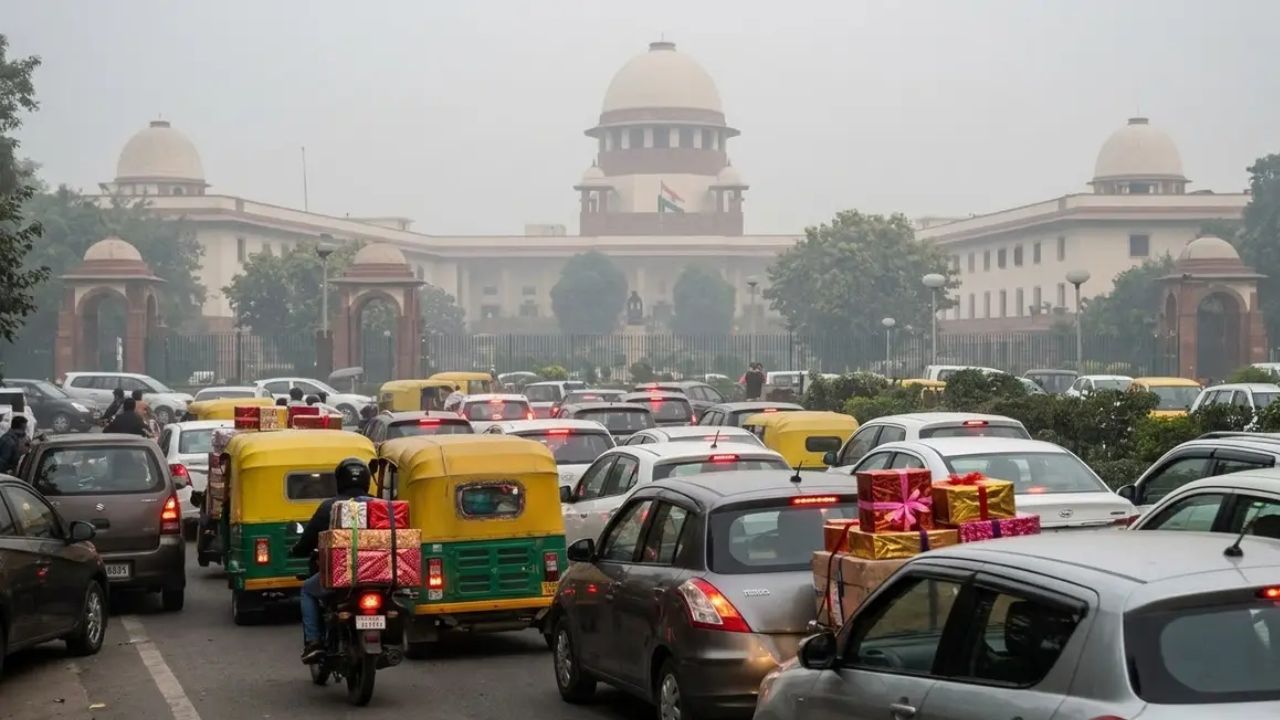
Delhi and three neighbouring states have been directed to explain how they have decided to control vehicular entry and movement in and out of the city, how they have implemented emission norms and why they are ensuring that polluting vehicles are not allowed to run on the Delhi roads when the vehicular emissions have become a major reason for the air quality in the city to go down.
In the order on Sunday, the bench headed by CJI Surya Kant and justices Joymalya Bagchi and V Mohana directed the Municipal Corporation of Delhi (MCD) and the Delhi government as well as Delhi Police's traffic department and the government of Haryana, Rajasthan and Uttar Pradesh to submit detailed responses regarding the regulatory mechanism for commercial and non-commercial vehicles in the national capital and the extended National Capital Region (NCR).
Also Read: Bombay High Court Cancels Former Cop Sachin Waze’s Bail in Antilia Explosives Case
The court particularly directed the authorities to inform the court about the procedure to identify and control the vehicles running without PUC certification and how they are prevented from entering and running overage, end-of-life and non-compliant vehicles.
It also wanted to know the number of vehicles that were checked, challaned, denied entry, or otherwise dealt with for violation, in addition to information on the coordination between the Delhi government and other states to monitor inter-state vehicle movement. The authorities have been requested to clarify further short and long term measures to reduce emissions from vehicles, as well as a timeframe plan for boosting enforcement.
Indeed, the Commission for Air Quality Management (CAQM) had earlier this year identified vehicles as the single largest contributor of air pollution in Delhi-NCR, during winter time when 23% of the pollution was recorded, and in summer time when 19% of the pollution was recorded.
The latest court order comes after the amicus curiae and senior advocate Aparajita Singh, and others solicitor general Aishwarya Bhati, informed the court in their evaluation of the compliance of the Graded Response Action Plan (GRAP) that there was a significant drop in the number of incidents of stubble burning in the region of Delhi, Haryana, Uttar Pradesh and Rajasthan between October 21 and November 3. Yet the same data revealed a “sharp increase in issues caused by vehicular emissions” that attracted the benches attention to another source of pollution they deemed as equally pressing.
The bench noted that this is commendable but there was also a countervailing and urgent problem in the data, that is, the rise in problems caused by the pollution of vehicles.
It said that Delhi and the NCR have a geographical and economic linkage and hence the cumulative impact of vehicular traffic not only within the NCR but also from adjoining states. The large number of commercial and non-commercial vehicles entering and moving in the region contributes to the existing emission load, it said.
“There is no doubt the issue is urgent and immediate, the bench said.”
The order also indicates that the Supreme Court will intensively review the various sources of pollution in separate proceedings, where it has issued separate notices to polluting authorities in companion suo motu cases regarding pollution from vehicles, green cover, construction activities and industries and solid waste management, including burning of crop residues and firecrackers.
The vehicular emissions issue will get the hearing on November 23, followed by the solid waste management and crop-residue burning and firecrackers case on November 25. Pollution due to construction activities, power plants, and industry will be taken up on November 26 and conservation and enhancement of green cover will be looked at on November 30. The following dates are dates on which the present proceeding shall be continued as the lead proceeding.
The court also granted the states two weeks to submit on record its own representations on the steps it has taken, as well as its response to any recommendations it has considered by the CAQM and amici curiae, and any steps it proposes to take on its own. The amici had noted that there had been no adequate reportage of compliance with the court's earlier orders of Jan. 21 and Feb. 23.
Also Read: Delhi Celebrates Diwali With Spectacular Drone Show, Bhajan Clubbing and Grand Maha Aarti
The new spotlight on vehicular pollution follows another smoggy Diwali night in the capital, where there are deficiencies in the air-quality monitoring network making it difficult to make a meaningful comparison with previous years. The monitoring stations in Delhi ceased to send data in excess of 50% of the stations during the midnight hours of Diwali night, despite the situation being very bad at some of the stations that continued to function.
An HT assessment of the PM2.5 sub-index revealed that at 9pm (when 57 stations were still reporting), 61% of these sites measured 400 or higher. Around 80% of the working stations recorded in ‘severe’ range from 10pm on Diwali till the following morning at 6am.
This year's peak hourly sub-index for PM2.5 was 655 at the hour ending 1am, compared to the previous years, where the highest sub-index was recorded at the same hour at six stations -- Alipur, Aya Nagar, Bawana, IHBAS-Dilshad Garden, Narela and Punjabi Bagh -- which reported data for most of the peak hours of Diwali in all years from 2021 to 2023. This was the third highest peak in the 6 years following, only 2021 when it was 812 and 2025 when it reached 752.
The analysis also revealed that the air quality in Delhi was worse than in any Diwali since 2021 most of November 8, till 7am and from 7pm till the end of the day, it was the second most polluted day. The subsequent improvement in its relative ranking was more likely to be due to favourable meteorological conditions than a significant reduction in the use of firecrackers, as meteorological data indicates that this was one of the warmer Diwalis since 2021 and winds during some hours assisted in spreading pollutants.
The order comes after a hearing on the matter held by the order on November 6, which posed questions to authorities about the effectiveness of the usual measures they take, such as traffic control and water sprinklers, and to determine what more could be done. It had also spotted the problem of vehicular pollution and congestion, citing bumper-to-bumper traffic in Delhi and its surrounding area like Noida and Gurugram.
Also Read: Why India's AQI of 387 Could Reach 1,500 in the US and Just 10 in the UK: Explained
For breaking news and live news updates, like us on Facebook or follow us on Twitter and Instagram. Read more on Latest World News on The National Bulletin
